
You may have heard the saying
you’re the average of the five people you spend the most time with.
Well, these days, many of us spend more time chatting with “AI buddies”—Gemini, Claude, ChatGPT, Copilot, you name it—sometimes more than we do with actual humans.
So, what does that mean for who we become?
Will we start to speak like AI? Think like AI?
For me, I’ve tailored AI responses to match my preferred formats, so they reflect my style—convenient, isn’t it? but it also raises an uncomfortable question:
“Could it change the way we think and the way we treat people?“
“Something big(ger) is (quietly) happening”
Everyone’s talking about AI “stealing all jobs,” but that’s not my main point here. (Though, as someone in a white-collar role, I’ve already seen AI outperform many tasks that my junior team members can do. With its pace, I am unsure if it will be better than my tomorrow self when I wake up.)
But my main concern is deeper and quieter:
AI is changing the way we connect—with our work, with our thinking, and with each other.
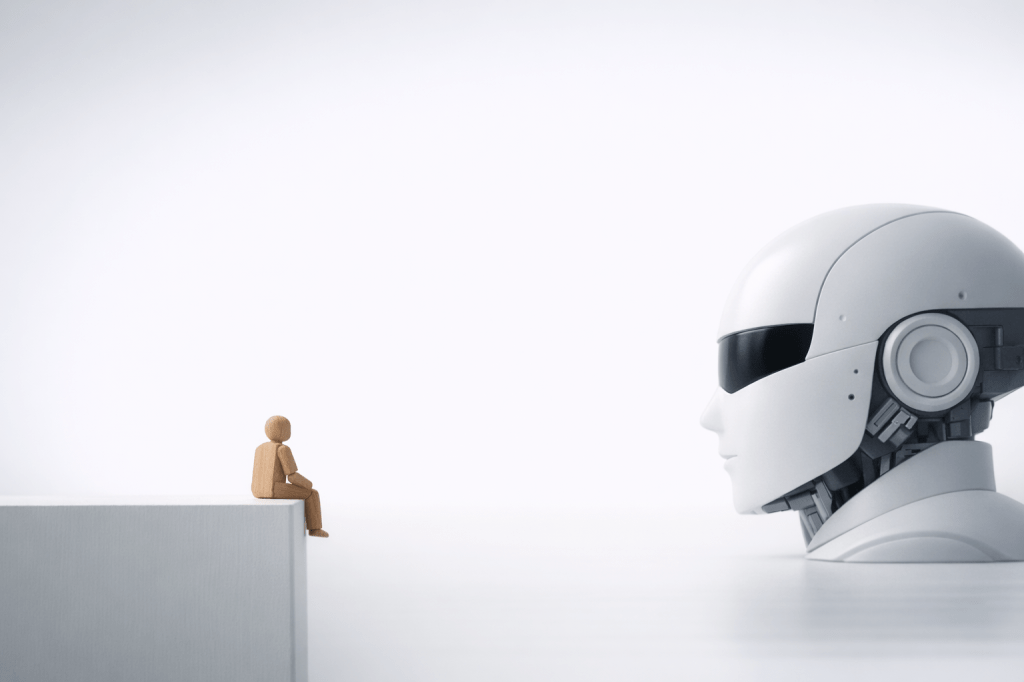
First, the thinking: Weaker muscles
Is it just me, or do you feel this too?
When talking to AI, I can use poor grammar and have a messy thought structure, and yet it still understands me, reorganizes my ideas into clean structure, and responds instantly and consistently.
I can write this post easily if I just tell Gemini what I want—the goal and the output I’d like. It might also write a better blog than me!
At work, we’re strongly encouraged to use AI in our day-to-day tasks. Yes, it boosts productivity and reduces turnaround times. Sometimes it even becomes a KPI: use AI more.
But just as relying on elevators weakens muscles, what “human muscles” weaken if we outsource friction all day long?
If we stop practicing the hard parts, will we lose the ability to think independently? What about other frictions? What will happen next?
To be clear, when I say “Less Human,” it doesn’t mean less intelligent (though the ability to think is certainly one of the core muscles.)
It means losing the traits that only humans possess: emotional depth, and the ability to tolerate another person’s emotions—even when friction is high.
It means losing the capacity to remain civil when walking away would be easier—and reacting would feel justified.
AI removes friction by design.
Human relationships are built through it.
Opportunity Costs
There are opportunity costs, too.
When talking to a real person, you must read the room, adjust your tone, and accept misunderstandings or delays.
When talking to AI, you don’t have to do any of that. You can yell, roll your eyes, or even walk if you’re not in the mood. All without any consequences. And when you return, AI is still there, picking up right where you left off, with the full memories of your conversation or tasks.
The more you do this, the less patience you have with humans, since you start expecting the same from people. At some point you might catch yourself thinking: “Why talk to a person when AI can answer faster, cleaner, and without drama?”
That thought is efficient but it’s also dangerous. It could diminish your desire to engage with people.
And when enough people adopt the same habit, it becomes the bigger issue: “The Network Effect.”
- People stop asking colleagues and ask AI instead.
- Conversations become shallower: fewer debates, fewer disagreements, fewer “let’s think together.”
- The team gets “productive,” but less connected.
I don’t think AI causes the butterfly effect—it’s on a much bigger scale. I would change the metaphor to an “elephant effect.”
and if AI is an elephant, you should be the Mahout.
How to be a Mahout
Yes, we must embrace AI to avoid being left behind. But the key question is: “How do we leverage AI while preserving irreplaceable human skills?”
If we use AI all day to summarize, compress, and do all the hard tasks, we risk losing the muscle to wrestle with complexity.
So here’s my practical take:
- Treat AI as a tool.
- Don’t live in it. Use it.
- If you are writing anything, draft it. Even if it will look far more worse than AI’s, but protecting your ability to think is a key. Then, use AI to refine.
- Use AI as a kit to escape the echo chamber (but first you must admit that you’re in one)
- Ask AI to challenge your ideas. You can prompt it to respond patiently—even to your swear words—in ways you might not be treated in real life.
- Spend your “patience budget” where it matters
- Since you don’t need to be patient with AI, save that energy for people. Show empathy.
- Think beyond opportunity costs: don’t just settle for “AI gives faster, better answers.” Ask yourself—what would I lose if I fail to show care for the humans around me?
Be a Mahout, my friend. Because when AI talks to each other, they may leave us behind.
All you’ll have left are your human relationships.
So stay smart, and stay kind.
 WHY-ING
Leave a comment